02
How to use
How should Fasal Amrit be used?
How should Fasal Amrit be applied in fields?
We recommend the granular type for field applications.
• Beds/rows: Apply 2–5 kg per 1,000 m² (10 ares/“10a”) along the bed/ridge, then till to incorporate evenly (aim for the root zone, ~5–10 cm deep).
• Seedlings: Place 1–5 g per seedling in the planting hole, mix lightly with the surrounding soil, then transplant.
Notes: Rates above are guidelines. Adjust for soil type, moisture, crop, and equipment. If it’s your first time, trial a small area and keep both soil and product dry at application for best mixing.
How should Fasal Amrit be applied when transplanting seedlings?
Apply about 1–5 g of Fasal Amrit directly into the planting hole, mix lightly with the soil, and then transplant the seedling.
How should Fasal Amrit be applied for seedling trays, potted plants, or container gardening?
For seedlings and container use, we recommend the powder type.
For seedling trays or planters: Mix Fasal Amrit with soil at a rate of about 1–10 g per liter of soil.
When sowing seeds: Mix Fasal Amrit with seeds at a rate of about 2 kg per 1,000 m² (10a) before planting.
Since soil types and environmental conditions vary, we recommend starting with a low concentration (around 0.1%) and gradually increasing as needed.
The above application rates are general guidelines and may vary depending on soil and growing conditions. Please start with a small trial before full application.
How should Fasal Amrit be applied to fruit trees or mature trees?
To enhance soil water retention and nutrient-holding capacity, Fasal Amrit should be applied around the root zone of fruit trees or mature trees.
A common method is to dig holes around the tree—similar to what is known as the “octopus pot method” or “trench method” in traditional orchard management.
In these holes, mix Fasal Amrit with soil (or with fertilizer and soil) and apply the mixture. Since tree roots naturally grow toward available moisture, this application method helps promote healthier growth and improved resilience against drought stress.
Are there any precautions I should be aware of when using Fasal Amrit?
Yes. Fasal Amrit does not naturally penetrate into the soil when sprinkled on the surface, so it must be thoroughly mixed into the soil. For best results, apply it to dry soil or fields, as mixing into moist soil may cause uneven distribution. The polymer itself should also be kept dry until use.
Please also make sure to follow the recommended application rates provided by our company. In particular, when using Fasal Amrit in pots or planters, avoid over-application, as it may cause soil compaction or stress to young roots.
Are there any crops that Fasal Amrit works especially well with?
We are currently conducting various trials to identify the most compatible crops. Promising results have been observed with grains (Poaceae family), tomatoes, okra, cabbage, leaf lettuce, carrots, potatoes, sweet potatoes, onions, pumpkins, broccoli, beets, sugarcane, and pineapples.
We have also confirmed certain positive effects in afforestation projects and turfgrass growth.
For more details, please refer to the “Field Trials” page on our website.
Are there any crops that Fasal Amrit is not compatible with?
We are conducting field trials with various crops. At present, no incompatibility with any specific crop has been observed.
Can Fasal Amrit be used in poorly drained soils?
Yes, Fasal Amrit can be used in poorly drained soils. Poor drainage often occurs because soil particles are too fine and lack aeration. When mixed into the soil, Fasal Amrit absorbs water and swells up to about 50 times its weight, then gradually releases the water and shrinks back to about 1/50 of its swollen size. This cycle of expansion and contraction creates air spaces within the soil, allowing oxygen to reach the roots and positively supporting plant growth.
Is it safe to mix Fasal Amrit with other materials?
Yes, we recommend mixing Fasal Amrit with dry fertilizers, pesticides, pellets, or similar materials. However, since we have not been able to test with all possible materials, if you notice any irregularities or unexpected results, please discontinue use and contact us for further assistance.
When is the best timing to apply Fasal Amrit?
In general, Fasal Amrit should be applied before planting. Spread and mix it thoroughly into the soil so that it is placed around the root zone. The most convenient timing will vary depending on the crop and the farming practices, but common options include before forming ridges or during fertilizer application.
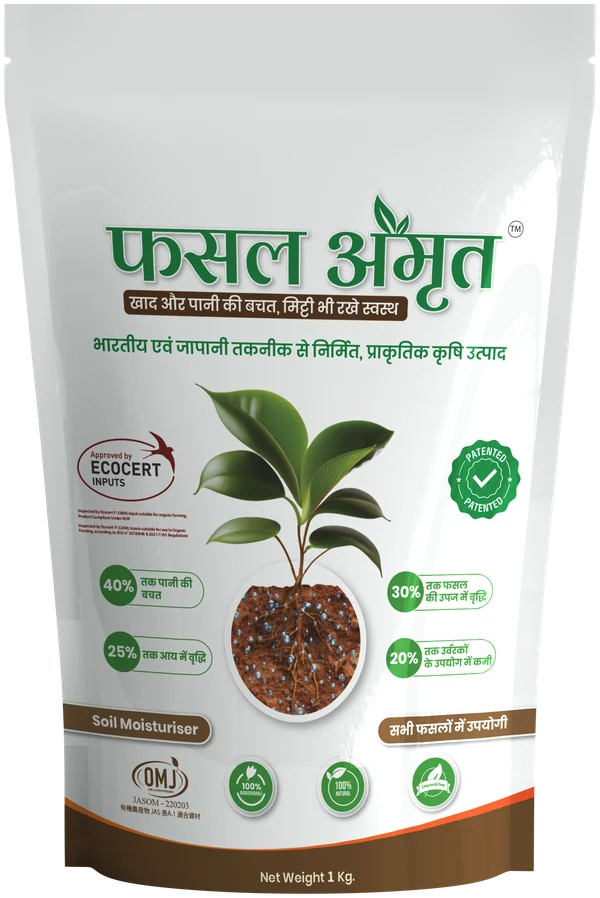
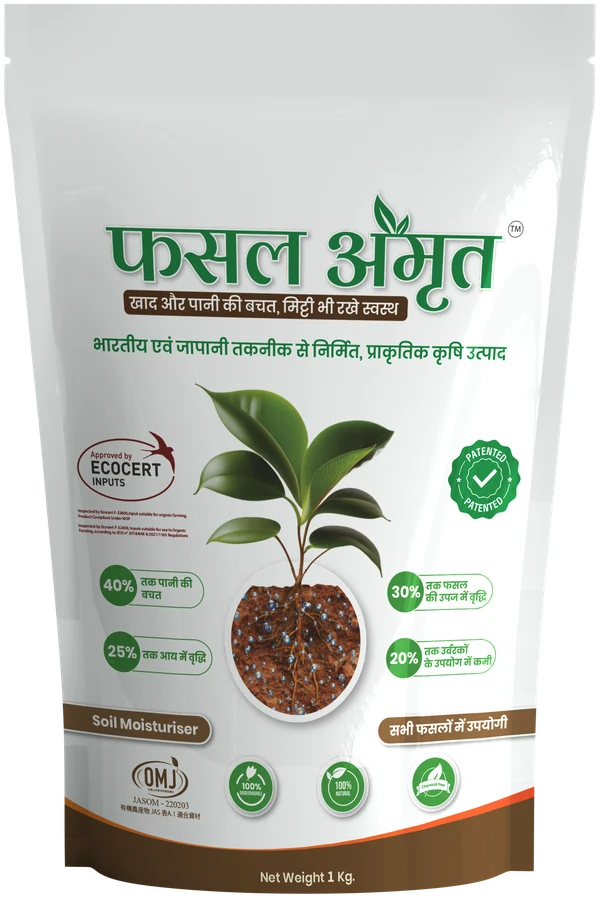
100% naturally-derived
Fully biodegradable